
【异构】并行任务计算
本文作者原创,首发在本博客;CSDN 上的同名文章已标注为转载并回链到本页:https://blog.csdn.net/qq_30220519/article/details/138729514
https://cdrdv2-public.intel.com/772402/onetbb_cookbook_2021.6-772401-772402.pdf
https://cdrdv2-public.intel.com/816904/onetbb_get-started-guide_2021.12-772618-816904.pdf
https://blog.51cto.com/shijianfeng/5152901
// 同构,多进程
https://github.com/microsoft/Microsoft-MPI // 消息传递接口 (MPI)
https://github.com/rabauke/mpl // 同类,Boost.MPI
MPICH | High-Performance Portable MPI
// 同构,多线程任务计算
https://github.com/ClearLove27149/TaskCpp
https://github.com/ddemidov/compute // GPU计算
https://github.com/oneapi-src/oneTBB#stable-releases // tbb
https://github.com/intel/tbb // tbb
// 异构,并行任务计算,支持流程
https://taskflow.github.io/taskflow/index.html
https://github.com/taskflow/taskflow.git
#include <taskflow/taskflow.hpp>
#include
// // Offload Tasks to a GPU
//__global__ void saxpy(int n, float a, float* x, float* y) {
// int i = blockIdx.x * blockDim.x + threadIdx.x;
// if (i < n) {
// y[i] = a * x[i] + y[i];
// }
//}
int test() {
tf::Executor executor;
tf::Taskflow taskflow;
auto [A, B, C, D] = taskflow.emplace( // create four tasks
[]() { std::cout << “TaskA\n”; },
[]() { std::cout << “TaskB\n”; },
[]() { std::cout << “TaskC\n”; },
[]() { std::cout << “TaskD\n”; }
);
tf::Task E = taskflow.emplace([](tf::Subflow& subflow) { // subflow task B
tf::Task B1 = subflow.emplace([]() {}).name(“B1”);
tf::Task B2 = subflow.emplace([]() {}).name(“B2”);
tf::Task B3 = subflow.emplace([]() {}).name(“B3”);
B3.succeed(B1, B2); // B3 runs after B1 and B2
}).name(“B”);
A.precede(B, C); // A runs before B and C
D.succeed(B, C, E); // D runs after B and C
// creates a feedback loop {0: cond, 1: stop}
tf::Task stop = taskflow.emplace([]() {}).name(“stop”);
tf::Task cond = taskflow.emplace([]() { return std::rand() % 2; }).name(“cond”);
cond.precede(cond, stop); // moves on to ‘cond’ on returning 0, or ‘stop’ on 1
//tf::Task cudaflow = taskflow.emplace([&](tf::cudaFlow& cf) {
// tf::cudaTask h2d_x = cf.copy(dx, hx.data(), N).name(“h2d_x”);
// tf::cudaTask h2d_y = cf.copy(dy, hy.data(), N).name(“h2d_y”);
// tf::cudaTask d2h_x = cf.copy(hx.data(), dx, N).name(“d2h_x”);
// tf::cudaTask d2h_y = cf.copy(hy.data(), dy, N).name(“d2h_y”);
// tf::cudaTask saxpy = cf.kernel((N + 255) / 256, 256, 0, saxpy, N, 2.0f, dx, dy)
// .name(“saxpy”); // parameters to the saxpy kernel
// saxpy.succeed(h2d_x, h2d_y)
// .precede(d2h_x, d2h_y);
// }).name(“cudaFlow”);
// Compose Task Graphs
tf::Taskflow f1, f2;
// create taskflow f1 of two tasks
tf::Task f1A = f1.emplace([]() { std::cout << “Task f1A\n”; }).name(“f1A”);
tf::Task f2B = f2.emplace([]() { std::cout << “Task f2B\n”; }).name(“f2B”);
tf::Task f1_module_task = f2.composed_of(f1).name(“module”);
f1_module_task.succeed(f1A, f2B)
.precede(f1A);
// tf::Future
// run_once.get(); // wait on this run to finish
executor.run(taskflow).wait();
// create asynchronous tasks directly from an executor
std::future
std::cout << “async task returns 1\n”;
return 1;
});
executor.silent_async([]() { std::cout << “async task does not return\n”; });
// create asynchronous tasks with dynamic dependencies
tf::AsyncTask AA = executor.silent_dependent_async([]() { printf(“A\n”); });
executor.wait_for_all();
// run the taskflow four times
executor.run_n(taskflow, 4);
// runs the taskflow five times
executor.run_until(taskflow, [ counter = 5]() mutable { return –counter == 0; });
// standard parallel CPU algorithms
//std::vector
//tf::Task task1 = taskflow.for_each( // assign each element to 100 in parallel
// data.begin(), data.end(), [](auto& i) { i = 100; }
//);
//tf::Task task2 = taskflow.reduce( // reduce a range of items in parallel
// data.begin(), data.end(), data.begin(), [](auto a, auto b) { return a + b; }
//);
//tf::Task task3 = taskflow.sort( // sort a range of items in parallel
// data.begin(), data.end(), [](auto a, auto b) { return a < b; }
//);
//// create a pipeline to propagate five tokens through three serial stages
//tf::Pipeline pl(“num_lines”,
// tf::Pipe{ tf::PipeType::SERIAL, [](tf::Pipeflow& pf) {
// if (pf.token() == 5) {
// pf.stop();
// }
// } },
// tf::Pipe{ tf::PipeType::SERIAL, [](tf::Pipeflow& pf) {
// printf(“stage 2: input buffer[%zu] = %d\n”, pf.line(), buffer[pf.line()]);
// } },
// tf::Pipe{ tf::PipeType::SERIAL, [](tf::Pipeflow& pf) {
// printf(“stage 3: input buffer[%zu] = %d\n”, pf.line(), buffer[pf.line()]);
// } }
//);
//taskflow.composed_of(pl)
// executor.run(taskflow).wait();
// dump the graph to a DOT file through std::cout
taskflow.dump(std::cout);
return 0;
}
创作不易,小小的支持一下吧!


C++内存泄漏分析
本文作者原创,首发在本博客;CSDN 上的同名文章已标注为转载并回链到本页:https://blog.csdn.net/qq_30220519/article/details/138706146
常用命令
- sudo apt-get install valgrind
- sudo apt-get install subversion && svn co svn://svn.valgrind.org/valgrind/trunk valgrind
- gcc test.c -g -o test #运行后,生成.out
- valgrind –suppressions=valgrind/runTest.sup –leak-check=full ./bin/runTest
- valgrind –leak-check=full –show-reachable=yes –trace-children=yes ./bin/runTest
- killall memcheck #守护进程泄漏检测
- killall callgrind #守护进程代码覆盖和性能瓶颈检测
- valgrind –tool=Memcheck(默认),callgrind,Addrcheck,Cachegrind,Helgrind(多线程分析),Massif(堆分析),DHAT,BBV ./bin/runTest #生成callgrind.out.pid
- callgrind_annotate –auto=yes callgrind.out.23202 >log #查看callgrind结果
- valgrind –tool=memcheck ls -l #命令内存检查
- –vgdb=yes,full –vgdb-error=0 –vgdb-stop-at=startup,exit,abexit,valgrindabexit #valgrind下gdb调试
- –log-file= #输出日志
- –run-cxx-freeres= #C++检测
- gdb prog && target remote | vgdb #开始gdb调试后,另shell远程gdb调试
示例代码:
#include <stdio.h>
#include <stdlib.h>
#include <string.h>
void f(void)
{
int* x = malloc(10 * sizeof(int));
x[10] = 0; // problem 1: heap block overrun
} // problem 2: memory leak – x not freed
void func() {
printf(“func call”);
func();
}
int main(int, int**) {
f();
//func();
printf(“hello\n”);
char *ptr = malloc(10);
ptr[12] = ‘a’;// 内存越界
memcpy(ptr+1, ptr, 5);// 踩内存
char a[10];
a[12] = ‘i’;// 数组越界
free(ptr);
free(ptr);// 重复释放
char *p1;
*p1 = ‘1’;// 非法指针
}
创作不易,小小的支持一下吧!


figma原型预览, 渲染场景动画切换闪动解决方案
本文作者原创,首发在本博客;CSDN 上的同名文章已标注为转载并回链到本页:https://blog.csdn.net/qq_30220519/article/details/138681699
切换场景过程中,增加视口自适应动画,场景完全切换后,视口也自适应到最终效果,最后切换时不会有闪动。
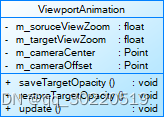
update:
totalZoom = m_targetViewZoom - m_sourceViewZoom;
curZoom = totalZoom * m_t; // m_t【0 - 1】 动画延迟归一化进度
sourceOpacity = opacity * m_t;
viewOffset = m_cameraOffset * m_t;
updateRender();
创作不易,小小的支持一下吧!
仿C#或Java基础类型自定义
本文作者原创,首发在本博客;CSDN 上的同名文章已标注为转载并回链到本页:https://blog.csdn.net/qq_30220519/article/details/138630208
1 | class Int{ |
operator类型名(): // C++11
explicit ( 表达式 ) operator 转换类型标识 // C++20
1 | Int i; |
其它示例:
class A
{
public:
operator char*() const // 隐式转换
{
return data;//当从其他类型转换到char*时自动调用
}
private:
char* data;
};
创作不易,小小的支持一下吧!
C++ 右值引用意义
本文作者原创,首发在本博客;CSDN 上的同名文章已标注为转载并回链到本页:https://blog.csdn.net/qq_30220519/article/details/138619023
1 | void reference(int& v) { |
1 | int& fn(){...} //返回类型为左值引用 |
左值引用是用于常规对象的引用和修改
右值引用是为了优化资源管理,特别是临时对象的生命周期终结时能将其拥有的资源高效地转移给新的所有者。
常见用法1:
std::vector::emplace_back(T &&val)
常见用法2:
class A;
A oldVal;
A newVal = std::move(oldVal);
常见用法3:
class A {
public:
A(int&& oldV) : v(oldV) {}
A(const A& b){…} //copy construct
A(A&& b){…} //move construct
int v;
}
int&& v = 0;
int oldV = 0;
A oldVal(oldV);
A newVal(oldVal);
常见用法4:
template<typename… Args>
void h(Args&&… args)
{
reference(std::forward
}
常见用法5:
1 | class A final |
1 | auto &&delayA = func(); // 延长临时对象生命周期 |
常见用法6:
std::string a = “…..”;
std::string_view refRightA = a;
创作不易,小小的支持一下吧!
Google Chrome 设备工具栏原理
本文作者原创,首发在本博客;CSDN 上的同名文章已标注为转载并回链到本页:https://blog.csdn.net/qq_30220519/article/details/138583985
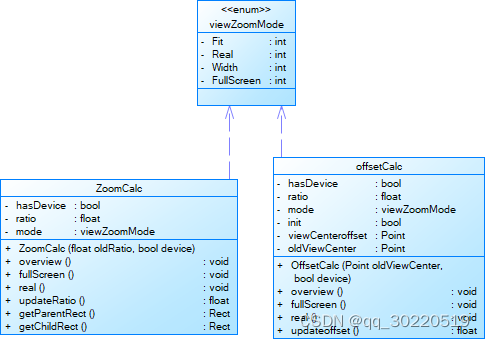
1.不同预览模式
2.计算出缩放比
3.固定滚动偏移
关键代码:
overview:
ratioW = getChildRect().width / getParentRect().width
ratioH = getChildRect().height / getParentRect().height
maxRatio = max(ratioW, ratioH)
if(maxRatio < 1)
return 1
else
return 1/maxRatio
oldViewCenter = viewCenterOffset
real:
if(bInit) { // 重置
if(childOutline.height < parentOutline.height)
oldViewCenter.fY = viewCenterOffset.fY;
else
oldViewCenter.fY = viewCenterOffset.fY + (childOutline.height - parentOutline.height) / 2; //顶部对齐
} else { // 滚动后拉伸
if(refParentOutline.top >= refChildOutline.top) //上次就无溢出
oldViewCenter.fY = viewCenterOffset.fY + (childOutline.height - parentOutline.height) / 2; //顶部对齐
else {
overflowLen = refParentOutline.top - refChildOutline.top //溢出长度
if(childOutline.height - overflowLen <= parentOutline.height) //溢出后下面留白
oldViewCenter.fY = parentOutline.bottom - childOutline.bottom // 底部对齐
else
oldViewCenter.fY = parentOutline.top - overflowLen - childOutline.top // 顶部溢出对齐
}
}
创作不易,小小的支持一下吧!
layout 自定义布局管理器
本文作者原创,首发在本博客;CSDN 上的同名文章已标注为转载并回链到本页:https://blog.csdn.net/qq_30220519/article/details/138580908
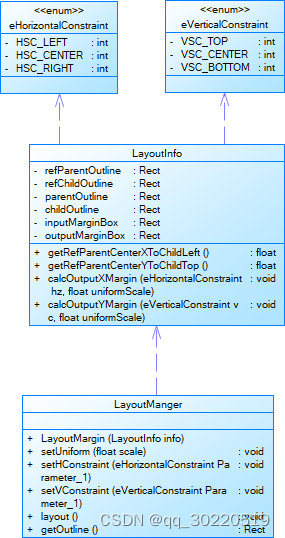
- 取参考的父子关系边距
- 设置布局,水平垂直约束,缩放和等比缩放
- 推算布局下子新的位置
关键代码:
inputMarginBox = refChildOutline - refParentOutline
if(HSC_RIGHT)
outputMarginBox.right = inputMarginBox.right;
outputMarginBox.left = parentOutline.width - outputMarginBox.right - refChildOutline.width * uniformScale
if(HSC_CENTER)
parentOutline.centerX - parentOutline.left - getRefBaseParentCenterXToChildLeft() * uniformScale
创作不易,小小的支持一下吧!
缺失模块。
1、请确保node版本大于6.2
2、在博客根目录(注意不是yilia根目录)执行以下命令:
npm i hexo-generator-json-content --save
3、在根目录_config.yml里添加配置:
  jsonContent:
    meta: false
    pages: false
    posts:
      title: true
      date: true
      path: true
      text: false
      raw: false
      content: false
      slug: false
      updated: false
      comments: false
      link: false
      permalink: false
      excerpt: false
      categories: false
      tags: true
很惭愧<br><br>只做了一点微小的工作<br>谢谢大家